The Digital Power Grab Coming to a Jurisdiction Near You
At vero eos et accusamus
Lorem ipsum dolor sit amet, consectetur adipiscing elit, sed do eiusmod tempor incididunt ut labore et dolore magna aliqua. Ut enim ad minim veniam, quis nostrud exercitation ullamco laboris nisi ut aliquip ex ea commodo consequat. Duis aute irure dolor in reprehenderit in voluptate velit esse cillum dolore eu fugiat nulla pariatur. Excepteur sint occaecat cupidatat non proident, sunt in culpa qui officia deserunt mollit anim id est laborum.
Public backlash prompts the Australian Government to retreat on some powers while introducing new ones.
After pioneering the world’s first social media ban for under-16s, the Australian Government has now set its sights on a much grander ambition: Minority Report-style laws to protect citizens from online “harms” before they occur.
You may not be Australian, but with teen bans now enacted or under consideration in dozens of countries worldwide, this regulatory experiment may soon arrive in a jurisdiction near you.
On Thursday, Communications Minister Anika Wells introduced the Digital Duty of Care Bill to Parliament before fronting the National Press Club, where she placed the legislation in Australia’s long history of pioneering public safety laws.
“We were the first in the world to make seatbelts compulsory. First with random breath testing. First with plain packaging.”
Anika Wells, National Press Club.
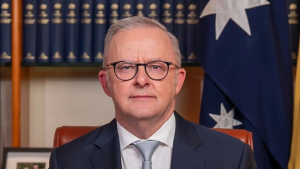
Wells made safety regulation sound as Australian as Steve Irwin and a Bunnings sausage sizzle. But a big Aussie backlash to the Bill’s exposure draft, released last month, has forced the Albanese Government to retreat on several fronts.
The concessions are welcome, but the Bill’s central ambition remains, and the revised legislation introduces some troubling new provisions.
One extraordinary addition exempts public officials (read: politicians and senior bureaucrats) from the bill itself.
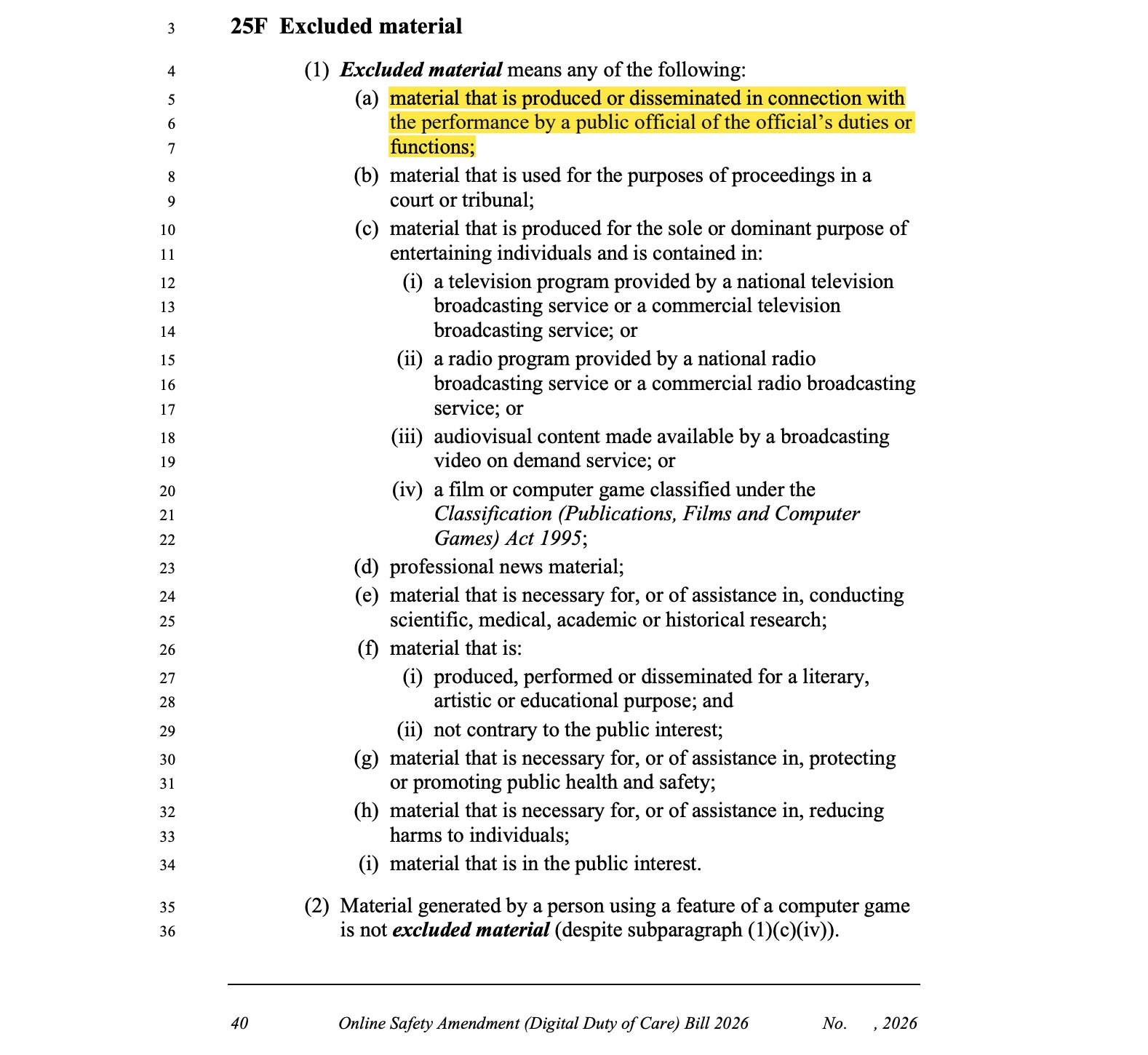
There are also carve-outs for groups such as “professional” news media and researchers, though the hoi polloi won’t enjoy the same privileges. Navigating such a list will be a nightmare for whoever is lumped with the task, but exemptions are exemptions nonetheless, so we’ll count it as a modest victory.
The most significant retreat concerns the Minister’s power to define online harm. Under the original proposal, she could expand the categories of “harmful” material through ministerial instruments, bypassing the need for new legislation. That power has now been removed, meaning any expansion of those categories must go through Parliament.
Another concession is the Bill’s sock puppet provisions. In our September investigation, we highlighted a little-noticed clause empowering Australia’s eSafety Commissioner to operate covert online accounts and generate AI material through them, “without limitation”.
The revelation drew significant media attention, including at the National Press Club address, where Wells was challenged on whether these powers could enable government propaganda. She flatly rejected the suggestion, insisting the power “does not exist; it’s not possible”.
This certainly wasn’t true of the older draft, but the provisions have been changed significantly:
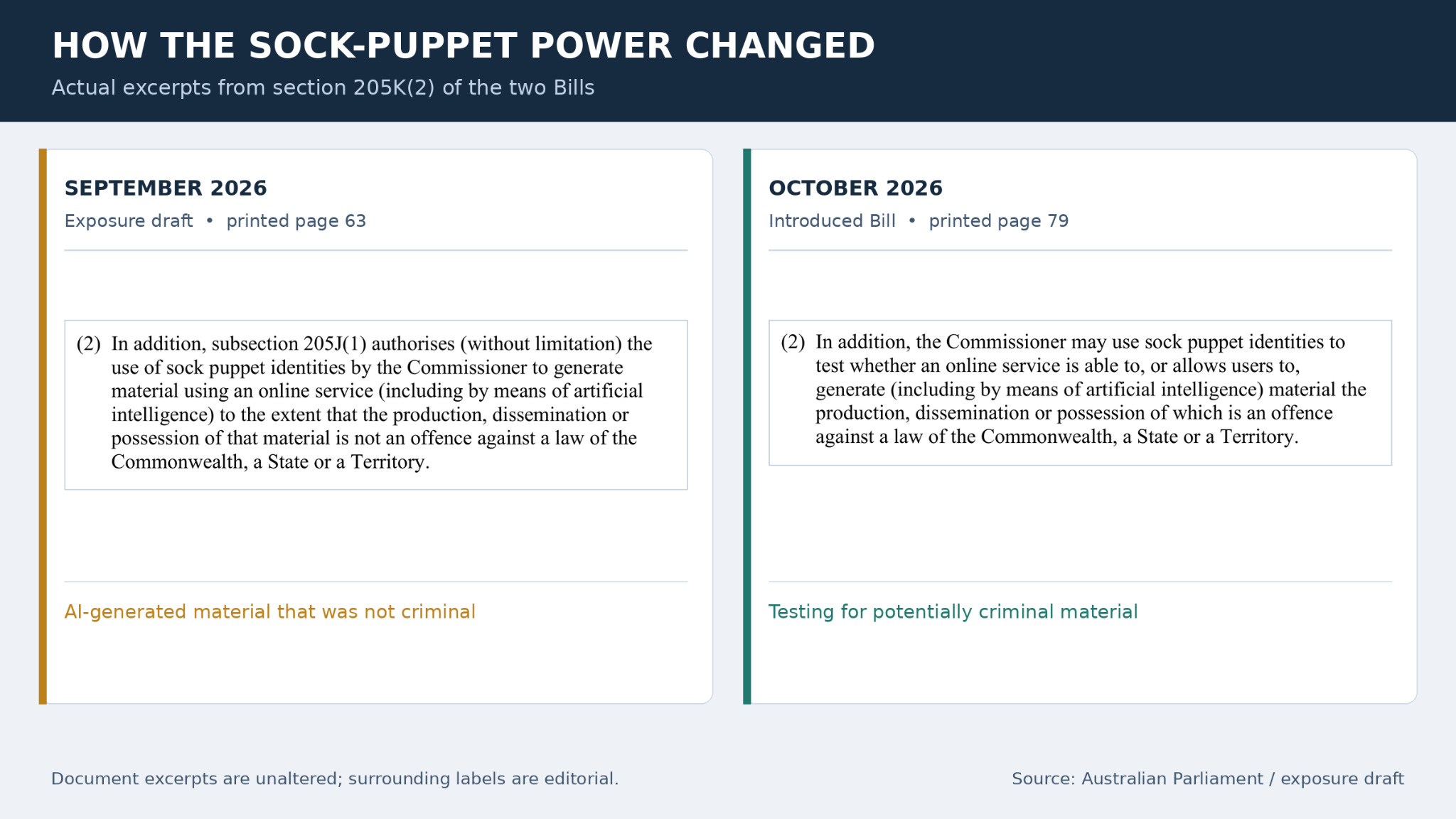
The revised Bill removes the two controversial instances of “without limitation” from the sock-puppet provisions. It also narrows the express AI-generation power to testing whether services can produce material that would constitute a criminal offence, and introduces mandatory annual public reporting on the eSafety Commissioner’s covert-account activities.
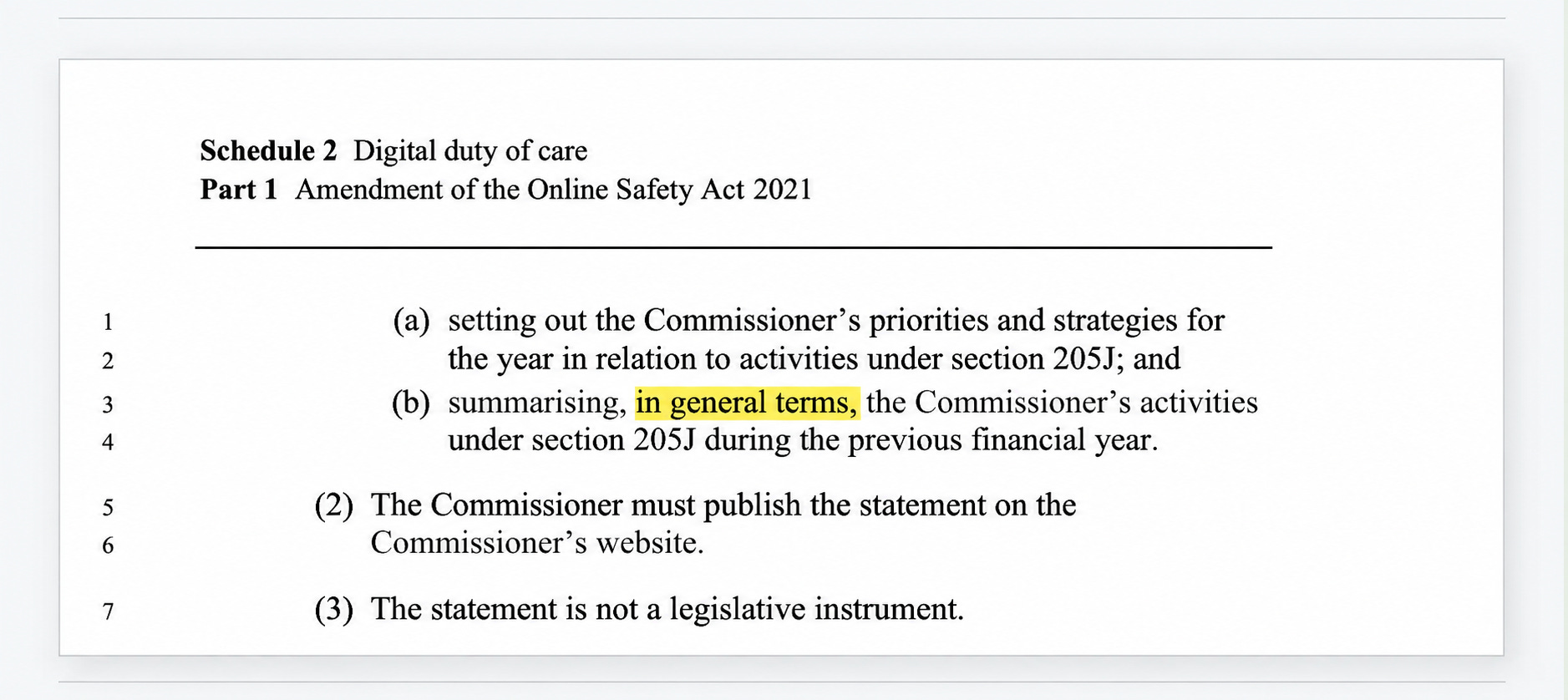
But the reporting requirement is extremely weak. The Commissioner needs only to summarise these activities “in general terms”, with no obligation to disclose how many fake accounts were operated, how many users they interacted with or what those interactions involved, what conversations were recorded or what material was posted.
eSafety-approved researchers exercising similar covert powers are exempt from this reporting requirement altogether. Our investigations have exposed extraordinarily close ties between government and these researchers. Government-allied NGOs like Reset.Tech have already produced questionable studies using sock-puppets that were used to promote the Digital Duty of Care.
Even under these revised provisions, eSafety and its approved researchers can still operate undisclosed fake accounts, with no explicit limit on how many they can run. They can covertly join online communities, observe, download and record material. They can also interact with real users as needed to keep their accounts open, while enjoying immunity from civil proceedings for actions taken in good faith under these powers.
The September exposure draft required platforms to weigh proposed safety measures against their financial cost and their impact on users’ privacy. Both considerations have now disappeared from the revised document.
In a strangely combative reversal, the new Bill expressly forbids platforms from taking financial costs into account. Section 26A(3) states:
“the cost of the action or measures must not be taken into account.”
Digital Duty of Care Bill, Section 26A(3)
But the removal of the privacy consideration is particularly concerning, given that preventing online harms will require platforms to monitor user behaviour and collect sensitive information.
Separately, the revised Bill removes an explicit safeguard preventing the eSafety Commissioner from publishing personal information or material protected by confidentiality obligations in transparency reports.
As we reported in our coverage of the exposure draft, the Bill designates eSafety an “enforcement body” under the Privacy Act, expanding its ability to access personal information. It also grants the body broader powers to share information across government.
Taken together, all these provisions create an online safety regime that can obtain and share personal information widely throughout government, while removing explicit safeguards against privacy intrusions and unauthorised disclosure.
The Government’s My Feed My Way initiative has finally been fleshed out. The much-touted promise of algorithmic choice arrived in a separate draft ministerial instrument rather than the Bill itself. Platforms like X, Instagram and TikTok already offer follow-only feeds. The new rules mainly change how that choice is presented to users and whether their preferences are retained. A modest reform, yet one that continues to do most of the heavy lifting in the Digital Duty of Care’s PR campaign.
Overall, some of the sting has been taken out of the Bill, but its central thrust remains. The Minority Report mission of preventing harms before they occur has survived, as have the sock-puppet provisions and eSafety’s sweeping new investigative and surveillance powers.
At the National Press Club, Anika Wells delivered a polished, if condescending, defence of the new safety measures, invoking internet horror stories and the reassuring precedents of seatbelt laws and anti-smoking campaigns. But amid the assurances came what sounded like a Freudian slip:
“We are controlling … we are not controlling free speech, we are not conducting covert surveillance.”
Anika Wells, National Press Club.
The Bill now faces a five-week Senate committee inquiry, due to report by 20 November. The Albanese Government seems determined to end the year with another censorship notch on its belt, gift-wrap the legislation for Christmas, then export it around the world. But the growing backlash may yet leave controlling the Australian internet on its list of New Year’s resolutions.