Digital Duty of Care: Australia’s New Speech Pacifier
At vero eos et accusamus
Lorem ipsum dolor sit amet, consectetur adipiscing elit, sed do eiusmod tempor incididunt ut labore et dolore magna aliqua. Ut enim ad minim veniam, quis nostrud exercitation ullamco laboris nisi ut aliquip ex ea commodo consequat. Duis aute irure dolor in reprehenderit in voluptate velit esse cillum dolore eu fugiat nulla pariatur. Excepteur sint occaecat cupidatat non proident, sunt in culpa qui officia deserunt mollit anim id est laborum.
Trading Open-ended Ministerial Powers for Promises

Australia continues to lead the world in online safety regulation, recently releasing a proposed Digital Duty of Care (DDoC) that would require social media platforms to preempt and prevent harm and give users greater control over their feeds.
It’s the latest expansion of Australia’s already ambitious online-safety regime, following the world-first under-16s social media ban introduced to great international fanfare and now facing serious questions about how well it works.
It comes as Prime Minister Anthony Albanese spruiks the new laws this week at the UN General Assembly and an Atlantic Council gathering of A-listers where he received a “Global Citizen Award”. Perhaps not incidentally, the Atlantic Council is among the world’s most aggressive advocates of digital censorship through its Digital Forensics Research Lab.
On its face, Australia’s proposed Digital Duty of Care (DDoC) is an easy sell: protect children from harmful material and give adults greater control over what appears in their feeds.
But beneath the pub-test-friendly promises is a massive expansion of regulatory power. The draft broadens eSafety’s investigative and data-collection abilities, authorises the use of covert online identities, allows open-ended changes through delegated legislation, and reaches into the systems and design features that determine what information Australians see online.
The new DDoC Bill is largely a package of amendments to the Online Safety Act of 2021. As we worked through the many tweaks and additions, what emerged was a case study in how protection can become a pretext for surveillance and control. In its full context, even the promised increase in user choice begins to look like a Faustian bargain, where Australians are asked to grant open-ended ministerial powers in exchange for a feature that some platforms already offer.
Among the measures that have so far escaped much public scrutiny are those expanding eSafety’s surveillance and data-collection powers. Greater access to what is happening on social media may be sold as research, but research can quickly become surveillance, and some of the Bill’s most concerning provisions sit right at that boundary.
The Bill expressly allows the government to create what it calls “sock puppet identities”. These are accounts operated under false identities that can observe and record material and, in some circumstances, interact with users.
More strikingly, the provision allows these state-created accounts to generate material using artificial intelligence:
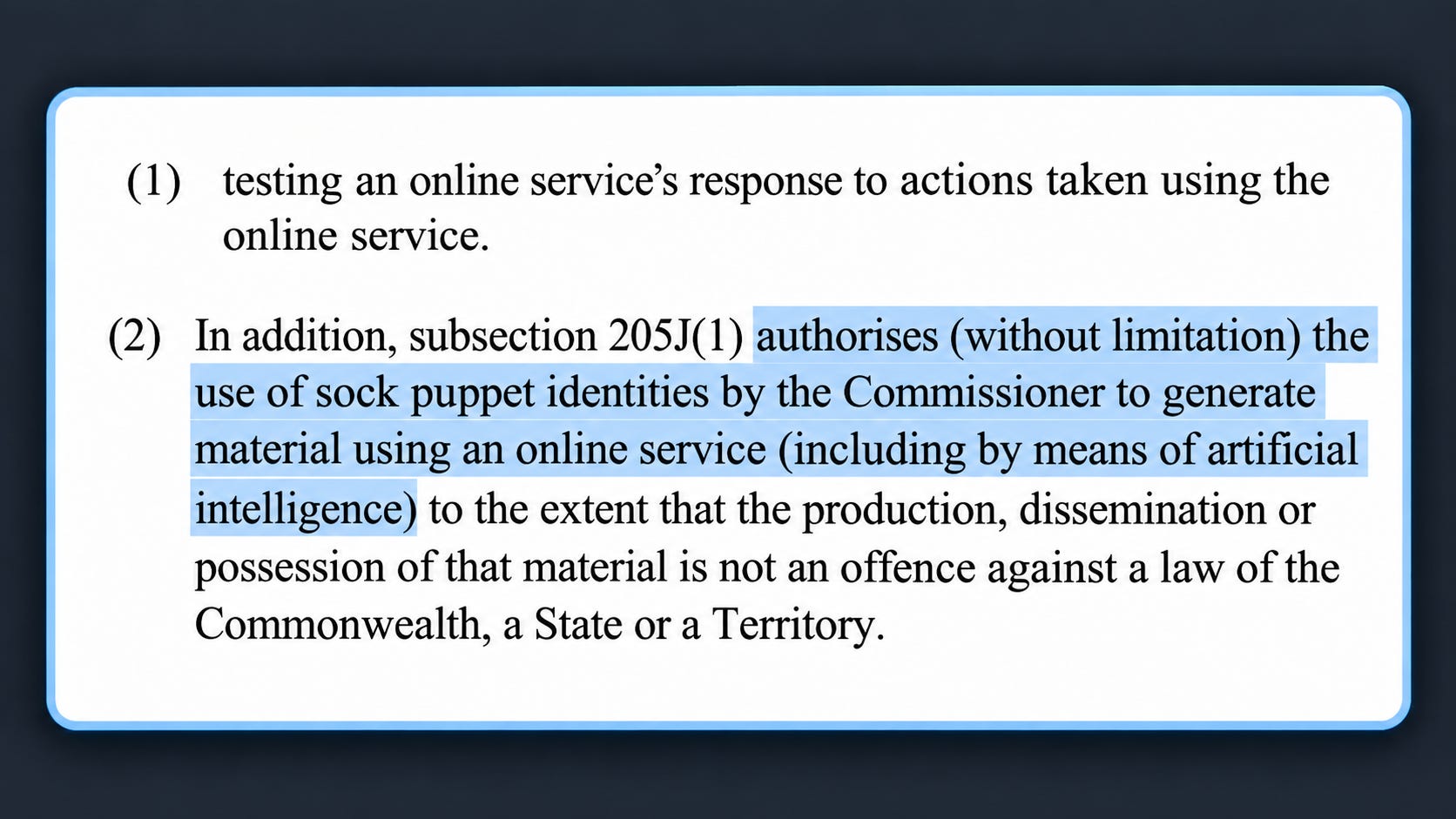
This particular clause moves well beyond passive observation and into active influence. Nowhere is the government clear about what it intends to do with these new powers, and the lack of clear limitations on potential uses leaves this as an open-ended question.
The Bill also makes significant changes to the Privacy Act 1988. It would designate the eSafety Commissioner as an “enforcement body”, bringing its activities within provisions dealing with surveillance, intelligence gathering and the collection of sensitive information without consent.
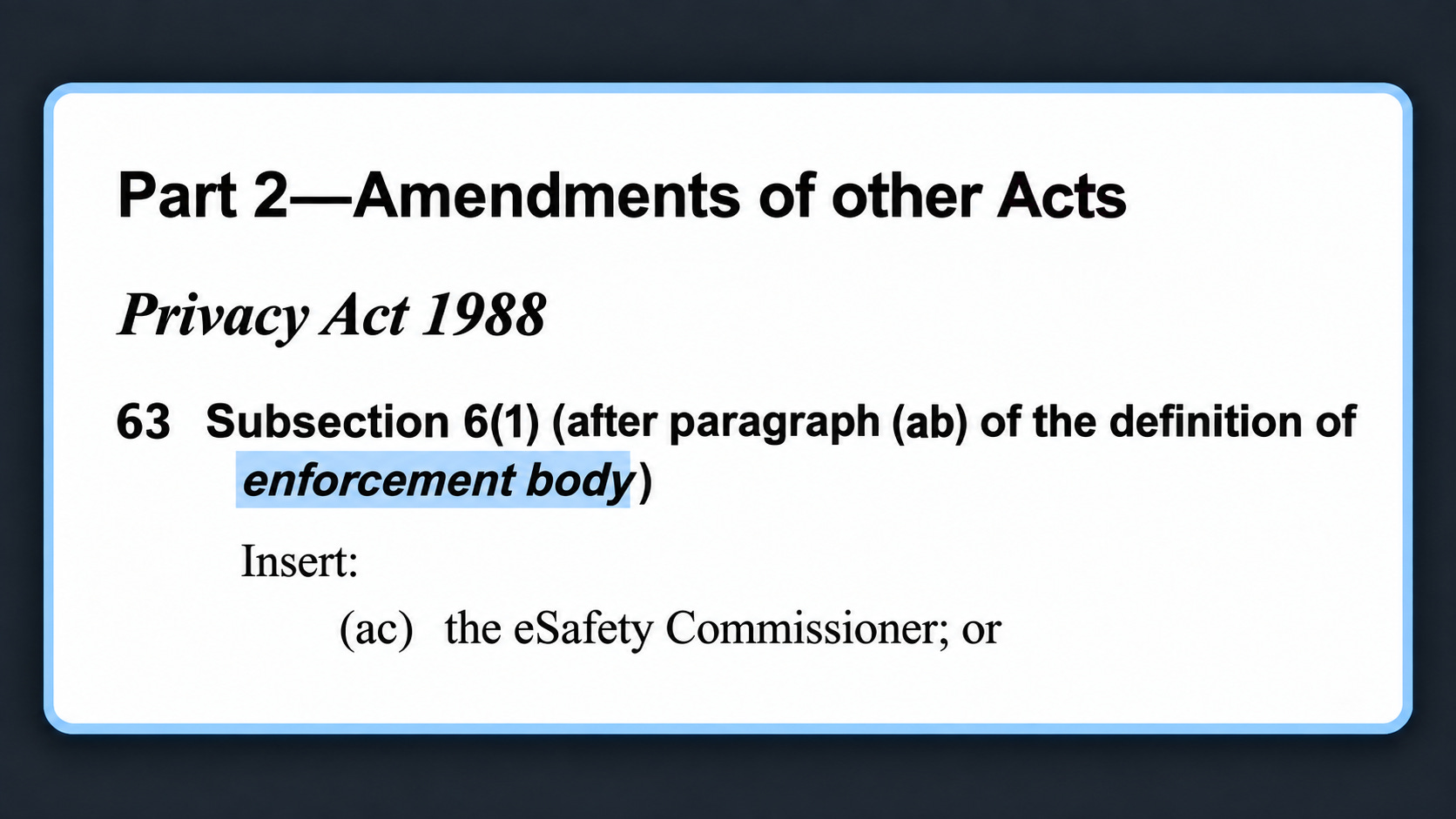
Another amendment widens the range of government bodies that are allowed to receive information obtained by eSafety.
Taken together, the changes mark an ominous development for Australians’ privacy. The online-safety regulator would gain broader powers to collect sensitive personal information without consent and share it widely across government.
Then there are moves to broaden regulatory power over lawful speech – the core ambition of the Albanese government’s earlier defeated ‘misinformation bill’, prompting accusations from some quarters that the DDoC is a means to smuggle the rejected misinformation bill back through the Parliament.
Much of what the legislation categorises as “harmful” is legal content, if often unsavoury. Platforms would be placed under preventative duties to create a “safe online environment” around these categories. The result is a new regulatory class of speech. It’s not illegal enough for Parliament to prohibit, but it’s considered harmful enough for the state to pressure platforms over how it’s distributed.
One proposed category that applies to Australians under 16 covers material or conduct that “encourages or promotes hostile attitudes towards women or gender equality”. Neither “hostile attitudes” nor “gender equality” creates anything like a clean boundary between objectively harmful conduct and political or cultural disagreement. It is also certainly not illegal.
This area is rife with live political disputes. A gender-critical argument about self-identification, a feminist argument about pornography, a religious sermon, a men’s-rights argument about family court, a traditional view of sex roles or even a stand-up routine could all conceivably be characterised as hostile by someone.
Once lawful disagreement sits inside a regulatory concept of “harm”, the question becomes who gets to decide where disagreement ends, and harm begins. Predictably, that power is intended to sit with the Minister, in consultation with eSafety.
The new machinery isn’t even tightly confined to children. The Bill would impose obligations around providing a “safe online environment” for all Australians with regard to “seriously harmful” material. While the current list captures content that is already illegal in Australia (e.g., child abuse, sexual violence, encouraging suicide), the Minister would have the power to add further categories of seriously harmful material through legislative instruments.
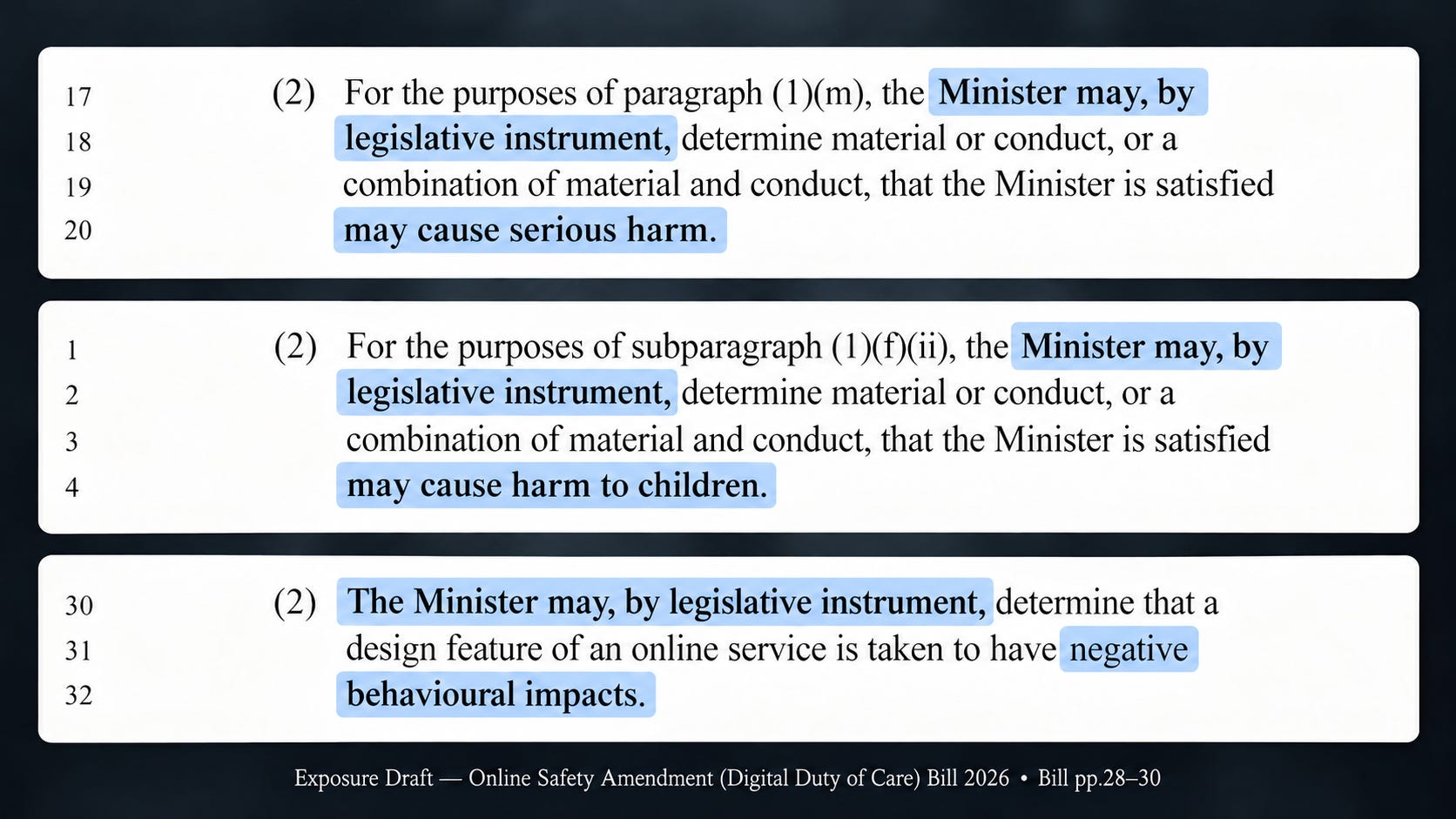
In basic terms, Parliament gives the Minister broad rule-making power now, and the details can be filled in later without passing a new law. The regime’s practical boundaries can therefore shift without another full legislative battle. Parliament can disallow new rules, but the process moves into a faster, lower-scrutiny channel with far less democratic oversight.
As if to demonstrate in real time the potential for this new regulatory machinery to be leveraged for political ends, Greens Senator David Shoebridge suggested at a recent press conference that the Bill was needed so political messages from Pauline Hanson and the Coalition, which he regarded as hateful, would not be amplified to children.
“We need digital duty of care so that those messages aren’t amplified and they don’t become the content that kids are digesting.”
Whatever you think of Hanson, the Coalition or Shoebridge, that should clarify what’s at stake here. Politicians are already thinking about this framework in relation to lawful political messages they interpret as socially harmful, a power neither side of politics would want in the hands of opponents with very different ideas about what constitutes harm.
Progressives would do well to think more than one step ahead and imagine what these laws might look like under a Right-populist government. They might decide that LGBT or trans content was harmful to children and decide to censor that. With One Nation currently leading in many polls, this is far from an impossibility.
Another part of the bill would give approved researchers employed by Australian universities mandated access to platform data, while keeping independent researchers out of the privileged access loop.
We find this seemingly benign move concerning because research is one of the core mechanisms through which a regulatory system justifies itself. Researchers collect and frame the data, regulators respond, researchers evaluate those responses, and their findings are cited as evidence for the next regulatory expansion.
That screeching sound you hear is the receiver mic of research getting too close to the speaker system of government. When privileged access to the underlying data is concentrated within a narrow institutional class, the government risks creating a closed knowledge loop.
We’ve seen this problem before. liber-net documented how US federal funding flowed into academic and nonprofit work on misinformation and content controls. Over time, government agencies, universities, NGOs, and tech companies coalesced into a biased ecosystem sometimes described as the “censorship-industrial complex”.
This is clearly the direction the DDoC is taking the country. A breach of the Digital Duty of Care carries a maximum civil penalty of 60,000 penalty units, currently up to $109.2 million for a corporation. Separate amendments also cut certain removal-notice windows from 48 to 24 hours, while imposing no equivalent penalty on platforms for suppressing lawful material.
Block first and ask questions later becomes the commercially safer choice.
For an Albanese government whose support has fallen sharply in recent polling, selling the package through child safety and consumer choice was the obvious play. But the sales pitch has started to unravel as Australians scrutinise the fine print and realise the Bill asks them to grant wide-ranging, open-ended powers now and just trust they’ll be used wisely later.
Albanese also let some of his broader political anxiety surrounding the policy show through in New York this week. While talking about the DDoC and giving Australians control over their feeds, he invoked misinformation and disinformation and warned that people were moving “away from the centre” towards the political extremes.
Germany’s regional elections this month offer a warning about where the instinct to suppress the political fringes can lead. Government overreach into the digital domain has proved no answer to populism and likely fuels the forces it attempts to contain. If people no longer trust the institutions governing them, giving those institutions more power over what they can see and say is an extraordinarily short-sighted response.
The problem isn’t the public’s perception of their government, but the reality of their government’s compounding failures. The sooner the digital nannies grok that and focus on managing material issues rather than public perceptions, the better for all of us.
If you would like more of the detail, you can read liber-net’s full submission here: https://liber-net.org/liber-net-submission-on-the-online-safety-amendment-digital-duty-of-care-bill-2026/