Germany’s HateAid sanctioned by the U.S. State Department
At vero eos et accusamus
Lorem ipsum dolor sit amet, consectetur adipiscing elit, sed do eiusmod tempor incididunt ut labore et dolore magna aliqua. Ut enim ad minim veniam, quis nostrud exercitation ullamco laboris nisi ut aliquip ex ea commodo consequat. Duis aute irure dolor in reprehenderit in voluptate velit esse cillum dolore eu fugiat nulla pariatur. Excepteur sint occaecat cupidatat non proident, sunt in culpa qui officia deserunt mollit anim id est laborum.
The organisation is among the most censorious of the more than 300 we profiled
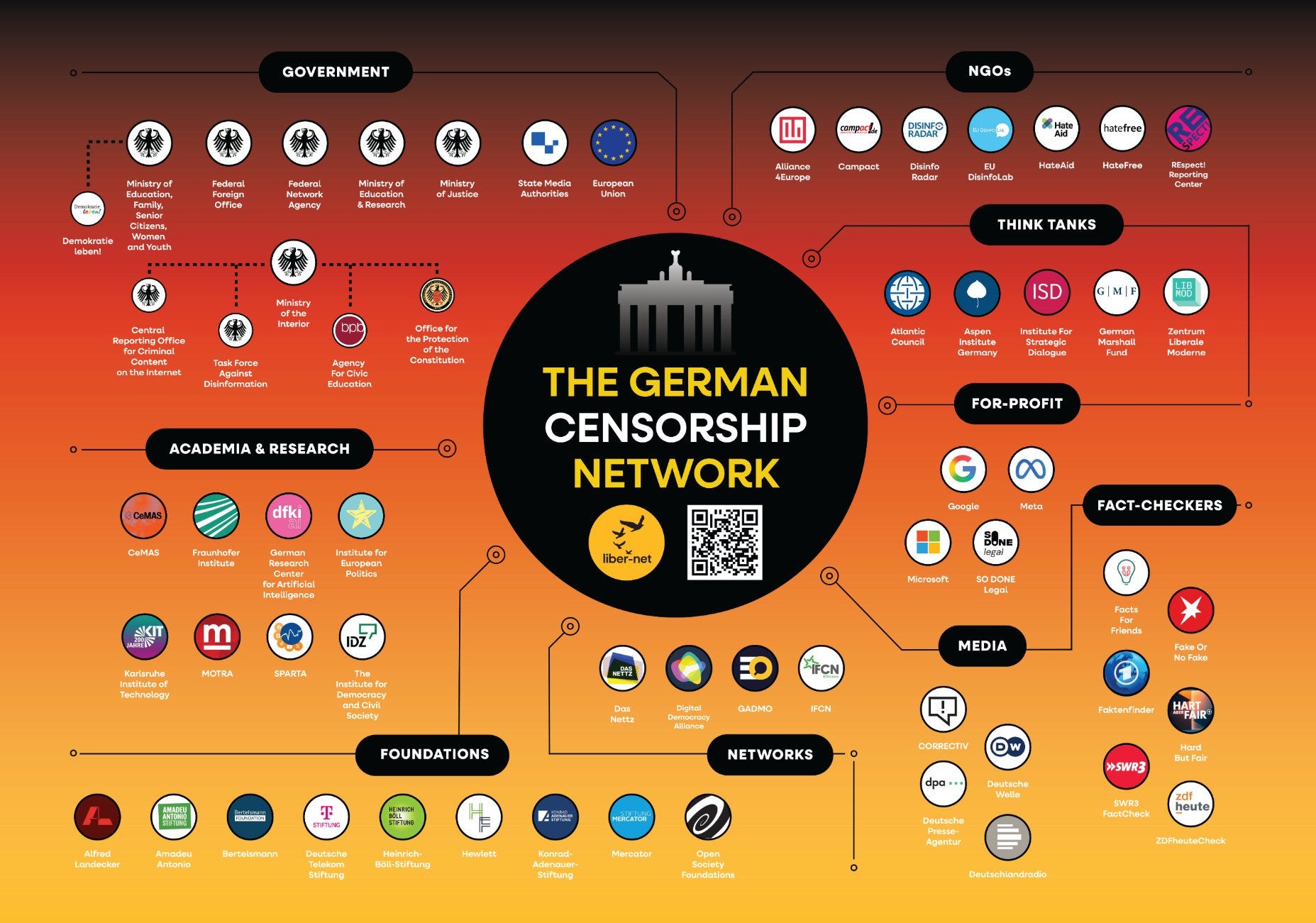
Last month, my non-profit liber-net released an investigation into the German Censorship Network. Included in that work is a database of more than 300 organisations, each with its own unique profile. Among those is HateAid, since June 2025, an EU Digital Services Act “Trusted Flagger” and among the censorship worst of the worst.
Today, U.S. Secretary of State Marco Rubio announced sanctions on five key censorship advocates, including the co-CEOs of HateAid, Anna-Lena von Hodenberg and Josephine Ballon. The sanctions are rather mild; they ban the pair from visiting the United States, but they bring attention to the pressing issue of digital censorship. The impact is likely felt more by the DC-based Imran Ahmed, the British CEO of the Center for Countering Digital Hate (CCDH), and among the extreme censorship advocates anywhere. Ahmed will now be forced to leave the U.S.
HateAid’s stated goal is to preserve freedom of expression to protect “democracy” and “human rights in digital space.” The organization operates principally in three domains: counselling for alleged victims of “digital violence”; political advocacy at the EU level; and legal in the courts through cases filed in the EU and German jurisdictions. This includes a lawsuit against Twitter/X, alleging its arbitrary suspension of a user for investigating the platform’s suspension policy, and a broader effort to ban users on Twitter/X accused of making anti-Semitic comments. Previously, in 2021, HateAid announced a case against Facebook to compel the platform to “remove illegal posts that have been uploaded and shared multiple times.”
Among its backers is the Federal Ministry of Justice (BMJ), which has in the past supported HateAid through a grant for the project “Hass als ganzheitlicher Bedrohung begegnen” (Addressing Hate as a Comprehensive Threat), in a project running from January 2020 to the end of 2022, amounting to €1,033,786.
HateAid’s efforts to increase the transparency of Twitter/X’s terms of use for its users may appear politically neutral, and indeed, the murkiness of the company’s standards for banning users is a genuine problem. But a closer examination of HateAid’s work reveals a distinctive political motive that contradicts its stated mission of protecting freedom of opinion.
The organization bases itself on the dubious concept of “digital violence,” which it defines as a digital communication causing, among other effects, “emotional stress” or “depression.” Far from protecting freedom of speech in civil society, and despite its potentially useful effort to scrutinize Twitter/X, HateAid should be understood as prioritizing the rights of officialdom to operate without criticism.
The bans come hot on the heels of Die Welt, one of Germany’s newspapers of record, profiling our recent censorship investigation. The profile sat at the very top of the site for half a day, garnered more than 1,500 comments, and was the most-read article this past Sunday, highlighting just how live this issue is right now (I’m not claiming any connection). You can read a non-paywalled version here; your browser should do a reasonable auto-translation.
Given the Trump administration’s patchy adherence to free speech principles, a sceptic might say the bans are more about protecting U.S. business interests than a genuine commitment to free expression. Either way, it’s a welcome shot across the bow and hopefully gives other censors and the “anti-disinformation” and “anti-hate speech” fields pause to consider their actions.
You can find the HateAid and other 300-plus profiles here.