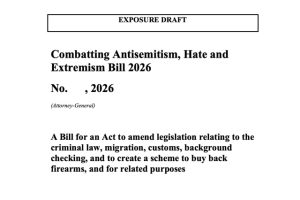
Letter to the Australian Parliament Regarding “Combatting Antisemitism, Hate and Extremism Bill 2026”
At vero eos et accusamus
Lorem ipsum dolor sit amet, consectetur adipiscing elit, sed do eiusmod tempor incididunt ut labore et dolore magna aliqua. Ut enim ad minim veniam, quis nostrud exercitation ullamco laboris nisi ut aliquip ex ea commodo consequat. Duis aute irure dolor in reprehenderit in voluptate velit esse cillum dolore eu fugiat nulla pariatur. Excepteur sint occaecat cupidatat non proident, sunt in culpa qui officia deserunt mollit anim id est laborum.
Under the banner of protecting its citizens from hate and extremism, the Australian government is pushing forward the Combatting Antisemitism, Hate and Extremism Bill 2026. While the stated intent appeals to public concern and moral urgency, the bill introduces expansive and loosely-defined powers that threaten freedom of expression, political dissent, and civil liberties.
Below is our letter to the Australian Parliament outlining our opposition to the bill:
TO:
Committee Secretary
Environment and Communications Legislation Committee
Department of the Senate
Parliament House
CANBERRA ACT 2600
AUSTRALIA
FROM:
Andrew Lowenthal, CEO, liber-net
15 January 2026
RE: Opposing Combatting Antisemitism, Hate and Extremism Bill 2026
Dear Parliamentarians,
My name is Andrew Lowenthal, an Australian and longtime proponent of free expression in the Pacific and across the globe. I am CEO of liber-net, a digital civil liberties initiative that combats digital authoritarianism and works to reestablish free speech and civil liberties as the norm for our networked age. I also have over 25 years working at the intersection of human rights and technology.
In recent years we have seen increasing acceptance of intrusive monitoring, speech restriction, and algorithmic governance of public life. This shift should concern anyone who values a free and pluralistic society. Combatting Antisemitism, Hate and Extremism Bill 2026 represents another step down this path. I write to express my opposition to the bill, which should be reconsidered rather than rushed into law.
Summary of Criticisms:
Discretionary powers invite political interpretation
Combatting Antisemitism, Hate and Extremism Bill 2026 provides broad and dangerous discretionary powers to the Australian Federal Police Minister, does not ensure due process, and creates opportunities for misuse against perceived political opponents.
While the Attorney General must agree to any designations of what the bill terms “prohibited hate groups,” there is no mandatory judicial oversight of the AFP Minister nor any direct appeal mechanism for the group itself. The only parliamentary review possible is by the Joint Committee on Intelligence and Security, which can recommend, but not enforce, changes. Given past politicisation of enforcement of speech laws by government — be it Home Affairs co-ordinating the takedown of memes during the pandemic, or eSafety going after ‘misgendering’ online — it is not only plausible but likely that this will lead to overreach where political or activist groups are unfairly swept up or even targeted.
This lack of due process appears to be a feature, not a bug. Indeed, who defines “hate”? The bill vests significant power in executive officials to define and apply the classification of hate to otherwise legitimate speech: while the current conceptualisations of “hate crimes” are explicitly tied to Criminal Code offences (e.g., urging violence against racial/ethnic groups) the bill expands this to include counselling, instruction, or praise that creates an “unacceptable risk” of leading to such crimes.
The bill’s vague standards are open to interpretation, crafted like a skeleton key for authorities to suppress public dissent against unpopular policies. While, to its credit, the bill acknowledges potential issues and risk of misuse by mandating a two-year review, this measly opportunity for oversight does not go anywhere near far enough.
Non-violence is the new violence: Pushing criminal law into new and unsafe territory
Protecting people from real-world harm, coercion, and intimidation is a legitimate and necessary function of the law. What should be resisted is the transformation of lawful expression into a criminal act where no tangible injury, threat, or victim can be established. This bill advances exactly that shift by attaching criminal consequences to speech on the basis that it might generate fear or offence, even in the absence of violence, physical injury, or a clearly identifiable harmed party.
Section 80.2BF, for example, creates a new crime for public conduct, including text or images shared on social media, intended to promote or incite hatred or ideas of superiority based on, among others, national origin, if it would cause a reasonable person in the targeted group to feel intimidated or fear violence/harassment. This “reasonable person” test is subjective and could easily sweep up provocative, but not explicitly dangerous, political commentary.
Such an approach breaks with long-standing principles of criminal justice, which traditionally require a demonstrable act, intention, or credible risk of harm. Under the proposed framework outlined by the bill, serious penalties, including multi-year prison terms, necessarily rest on contested or imagined interpretation rather than objective evidence.
Indeed, a substantial body of powers already exist in our country to address genuine threats to safety and national security: counter-terrorism offences and preparatory offences, preventative and control orders, extensive intelligence and surveillance authorities, migration and character-based exclusion powers, and coordinated watch-listing and information-sharing systems across agencies, among others. By international standards, these capabilities are already expansive. If these mechanisms exist to manage real risk, why is the legislative response now focused on expanding speech-based criminal liability instead of improving the consistent and accountable use of existing tools?
Masking governance failures and avoiding political accountability
When individuals who are assessed as dangerous or closely monitored are nevertheless able to operate freely in the community, ultimately causing real, physical harm, the problem is not usually a shortage of legislative authority. Instead, it points instead to weaknesses in enforcement, prioritisation, coordination, or policy execution.
Broadening the criminal net to capture increasingly wide categories of expression, including online commentary, does not remedy Australia’s operational shortcomings. Rather, it risks diverting attention and accountability away from whether institutions are effectively using the powers they already possess.
Recent regulatory and legislative trends in our country show a pattern: social tension and isolated acts of violence are increasingly met with attempts to tighten speech regulation rather than serious engagement with underlying causes. Australia has followed a path similar to other liberal democracies, particularly the United Kingdom, where complex social and political problems are treated as technical compliance issues to be managed through regulation and platform controls. This technocratic reflex may create the appearance of decisive action, but it often serves to suppress underlying core issues and dissent rather than resolving them.
Political leaders benefit from measures that signal control and unity while insulating them from scrutiny over difficult policy areas — including intelligence failures, inconsistent messaging, migration policies, and the willingness to confront antisemitism clearly and directly. Instead of addressing these contested domains openly, the impulse appears to be to manufacture surface-level harmony by constraining expression. New South Wales Premier Chris Minns said as much when, justifying his state’s new hate speech laws, he explained that the reason we don’t have fulsome speech protections like those in the U.S. is that “we want to hold together our multi-cultural community.” This approach risks entrenching resentment, weakening democratic feedback, and substituting image management for genuine problem-solving.
The rise of eSafety has proved Australia to be a testing ground for the most extreme policies of technocratic opinion-management. This is part and parcel with allowing a short 48-hour public submission window for this committee inquiry; limiting scrutiny is the name of the game, both within the operations of designating “hate speech” and in attempting to pass legislation with limited opportunity for opposition. True to recent form, our country’s leadership is attempting to force a mirage of aligned public opinion in an age of an expansive, diverse, and multicultural digital public sphere.
Australia is once again a frontrunner in the global push for speech control efforts. It is for these above reasons that I strongly oppose the bill.
Sincerely,
Andrew Lowenthal
CEO, liber-net